Composite vs. pressure-treated decking
Composite costs about twice as much to build and needs almost nothing afterwards. Pressure-treated is cheaper up front and needs staining every couple of years. Whichever you pick, get the ledger connection to the house right, because that's where decks most often fail.
ModelQuoter EditorialPublished Jun 3, 2026Reviewed September 2026
Applies to: US and Canada. Ledger fastening and guard rules are code in both. Footing depth follows the local frost line.
The short answer
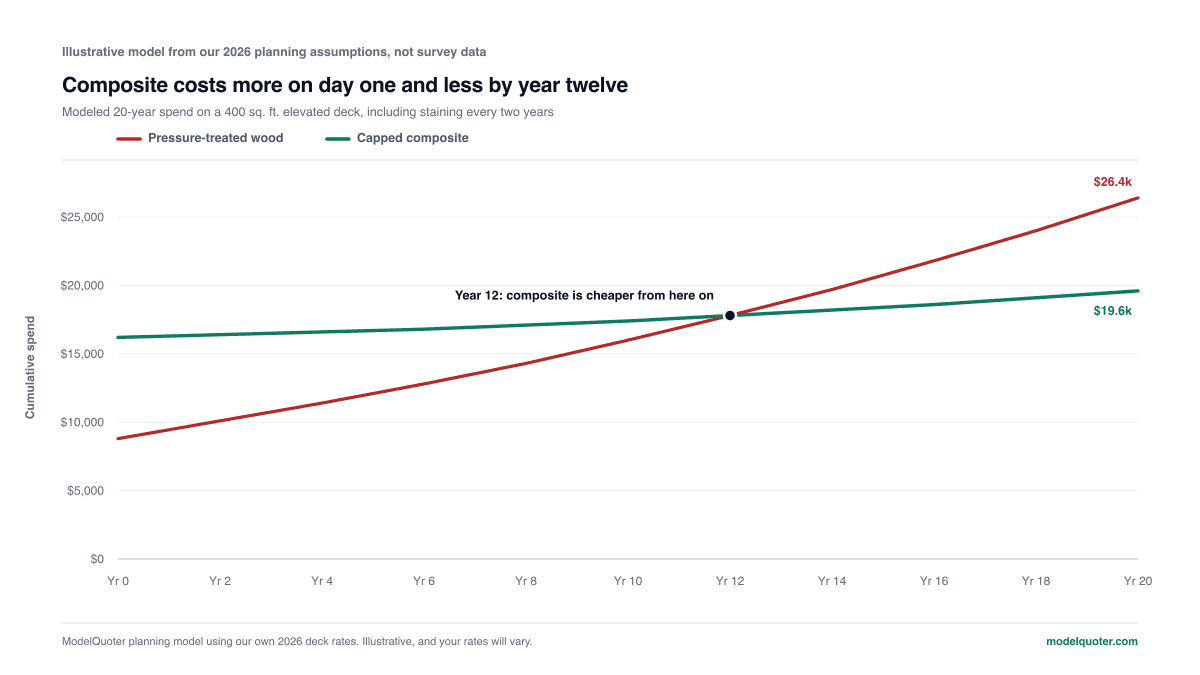
- Where the total costs cross
- Around year 12 in our planning model
- Pressure-treated upkeep
- Clean and stain about every 2 years
- Composite upkeep
- Wash it
- The safety item
- The ledger connection
What a typical project costs
Composite deck
300 sq ft, railing, stairs
$28,200–38,190
Installed, before tax, at 2026 Greater Toronto rates.
See it on my houseOpen the calculator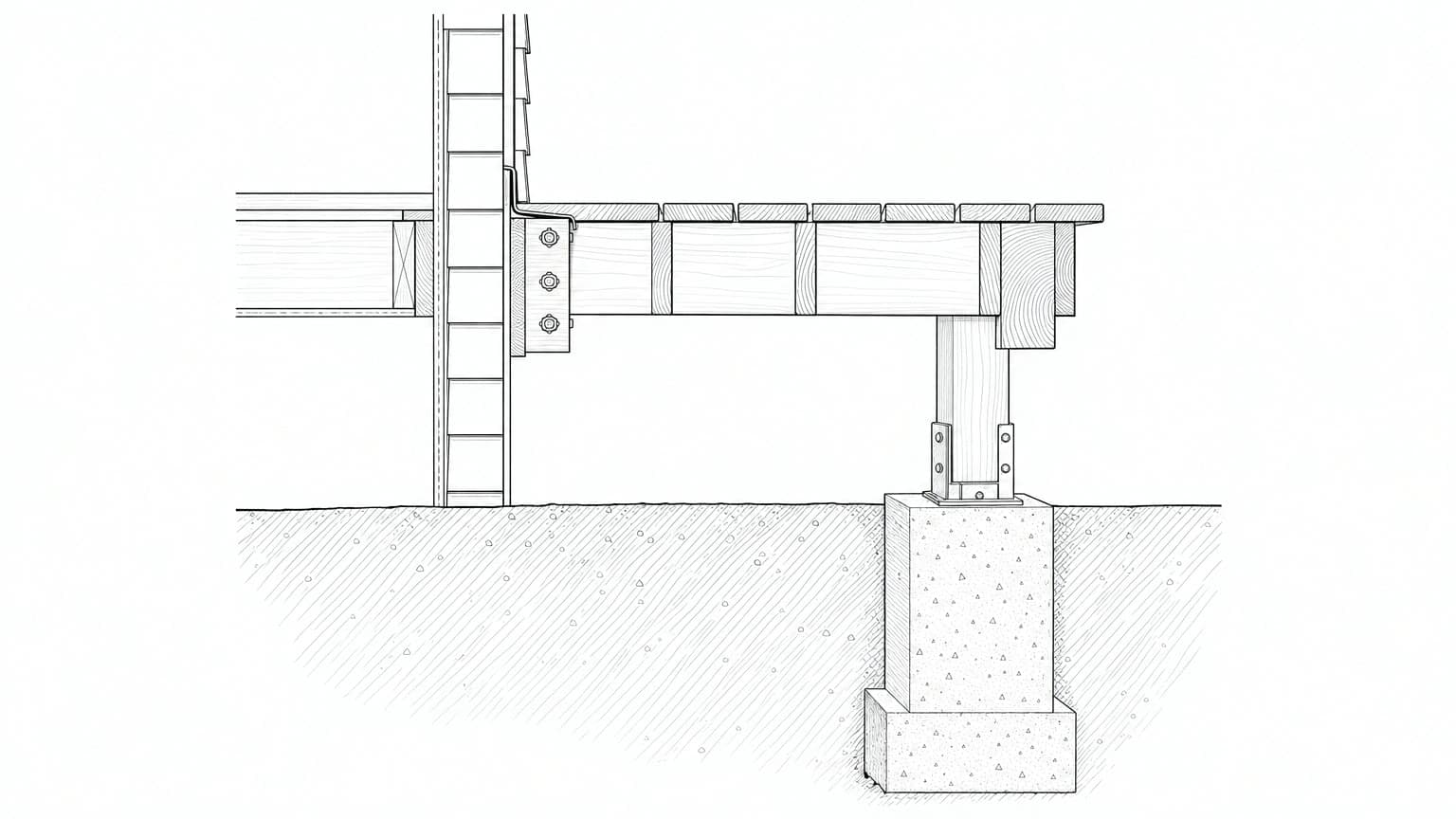
- Flashing over the ledger, tucked up behind the siding, so water can’t get behind it.
- The ledger, bolted to the house’s rim joist. This connection is where decks most often fail.
- Joists run from the ledger out to the beam.
- A metal bracket ties the post to its footing.
- The footing, below the local frost line, on undisturbed soil.
Start with the ledger
When a deck collapses, it's usually the ledger that fails. That's the board where the deck attaches to the house, and when it pulls away, there are usually people standing on the deck. It's the most important safety detail in the whole structure, and you can't see it once the deck is finished.
If you've just moved into a house with a deck, look underneath it. These are the problems to look for:
- Nails instead of bolts. The classic failure. Nails slowly pull out under repeated loads.
- No flashing. Water sits behind the ledger and rots the rim joist from the inside.
- A ledger fastened to brick veneer. Veneer isn't structural and can't hold up a deck.
- A ledger fastened over the siding. It leaves a gap, puts all the load on the fasteners, and traps water.
- No lateral connection. The deck holds its weight fine but has nothing stopping it from pulling away from the house.
- Posts sitting on soil, or soft wood at any connection.
Deck failures happen most on decks a previous owner built without a permit. Checking yours takes an afternoon and costs nothing.
A freestanding deck on its own posts avoids the ledger entirely, and on a difficult wall it's often the better choice. It needs more footings, which is a small cost for removing the riskiest part of the structure.
The decking itself
Pressure-treated lumber is the default for good reasons. It's cheap, every lumberyard has it, and any carpenter can work with it. The cost that doesn't show up in the quote is the staining: a full clean and new coat every couple of years, either as your weekend or as a contractor's invoice.
Capped composite has a core of wood fibre and plastic with a protective shell bonded around it. It doesn't rot, doesn't need staining, and holds its colour much better than the early versions did. It costs about twice as much installed, and it does need some care. You wash it instead of refinishing it.
Footings, railings and permits
| Part | What's required, roughly |
|---|---|
| Footings | Below the local frost line, on undisturbed soil, sized for the load |
| Posts | Anchored to the footing; a post resting loose on it or buried in soil fails |
| Railing height | Required above a certain height off the ground; usually 36–42 inches on houses |
| Balusters | No gap wide enough for a 4-inch ball to pass through |
| Stairs | Every step the same height and depth, with a handrail you can grip |
| Permit | Usually needed above a height or size limit, and for any deck attached to the house |
In the US, the IRC exempts decks under 200 sq ft that sit no more than 30 inches above the ground and aren't attached to the house. Attaching it to the house is what usually triggers the permit.
Design a deck you'll use
Decks often get sized by what fits instead of what you'll do on them, which is how people end up with a big deck and one small table.
- Furniture takes more room than you think. A dining table with the chairs pulled out needs about 12 by 12 feet on its own.
- Leave a path. Keep a clear route past the furniture to the stairs and the door. People stop using a deck they have to squeeze across.
- Mind the door threshold. The deck surface has to sit far enough below the inside floor to keep water out, which affects the framing depth and the number of steps.
- Think about the sun. A west-facing deck with no shade is too hot on summer evenings, which is exactly when you want to use it.
- Plan the stairs early. They take a lot of space, and where they land shapes the yard around them.
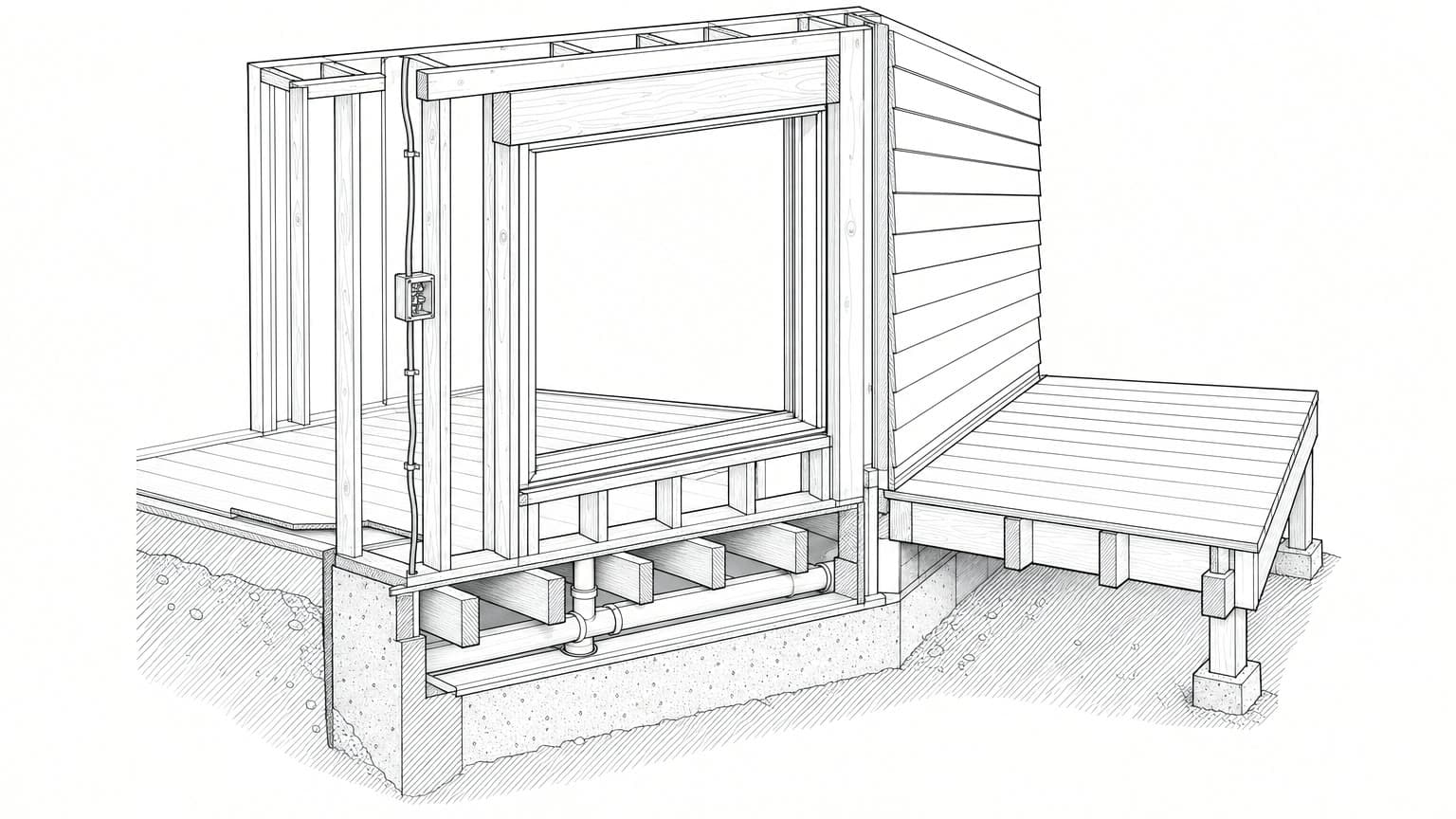
- Run wiring and gas while it's framed. Lights, an outlet or a gas line for the barbecue are easy while the frame is open and a pain afterwards.
A low deck is cheaper and simpler. Above a certain height a deck needs railings, and above a higher one it usually needs a permit and bigger footings. A deck one step down from the door often avoids both and looks better against the house. If the ground allows it, consider that before defaulting to a raised deck. If you do build high, decide early what happens underneath: storage, a drainage system, or just open access. It's much cheaper to plan than to add later.
Questions homeowners ask
Does composite get hot in the sun?
Yes, noticeably hotter than wood, and dark colours more so. If the deck faces south and people walk on it barefoot, pick a lighter colour and ask the supplier for surface temperature data.
Can I put composite boards on my existing frame?
Only if the frame is solid and the joists are as close together as the composite maker requires, which is often closer than wood decking needs. Adding joists is common. Check before you buy the boards.
How long does pressure-treated wood last without stain?
The treatment keeps it from rotting for a long time, but it'll turn grey, crack and split. Unstained decks usually get replaced because they look bad and give splinters, long before they fail structurally.
Price a deck by size, decking and railing in our free deck calculator.
Open deck calculator