Building a fence on a property line
Old fences are often built off the property line, so confirm the real line with a survey or the corner pins before you build. Then check your local height limits and put any agreement with your neighbour in writing.
ModelQuoter EditorialPublished May 13, 2026Reviewed September 2026
Applies to: US and Canada. Boundary law, fence height limits and cost-sharing rules are all local. The principles here apply broadly; the specifics come from your state or province and your municipality.
The short answer
- The only reliable line
- A current survey tied to the corner pins
- Usual height limits
- About 4 ft in front, 6 ft at the back
- Also watch for
- Corner visibility triangles
- Before you build
- Tell your neighbour, in writing
What a typical project costs
Cedar privacy fence
84 ft, gate, old one out
$8,290–9,750
Installed, before tax, at 2026 Greater Toronto rates.
See it on my houseOpen the calculator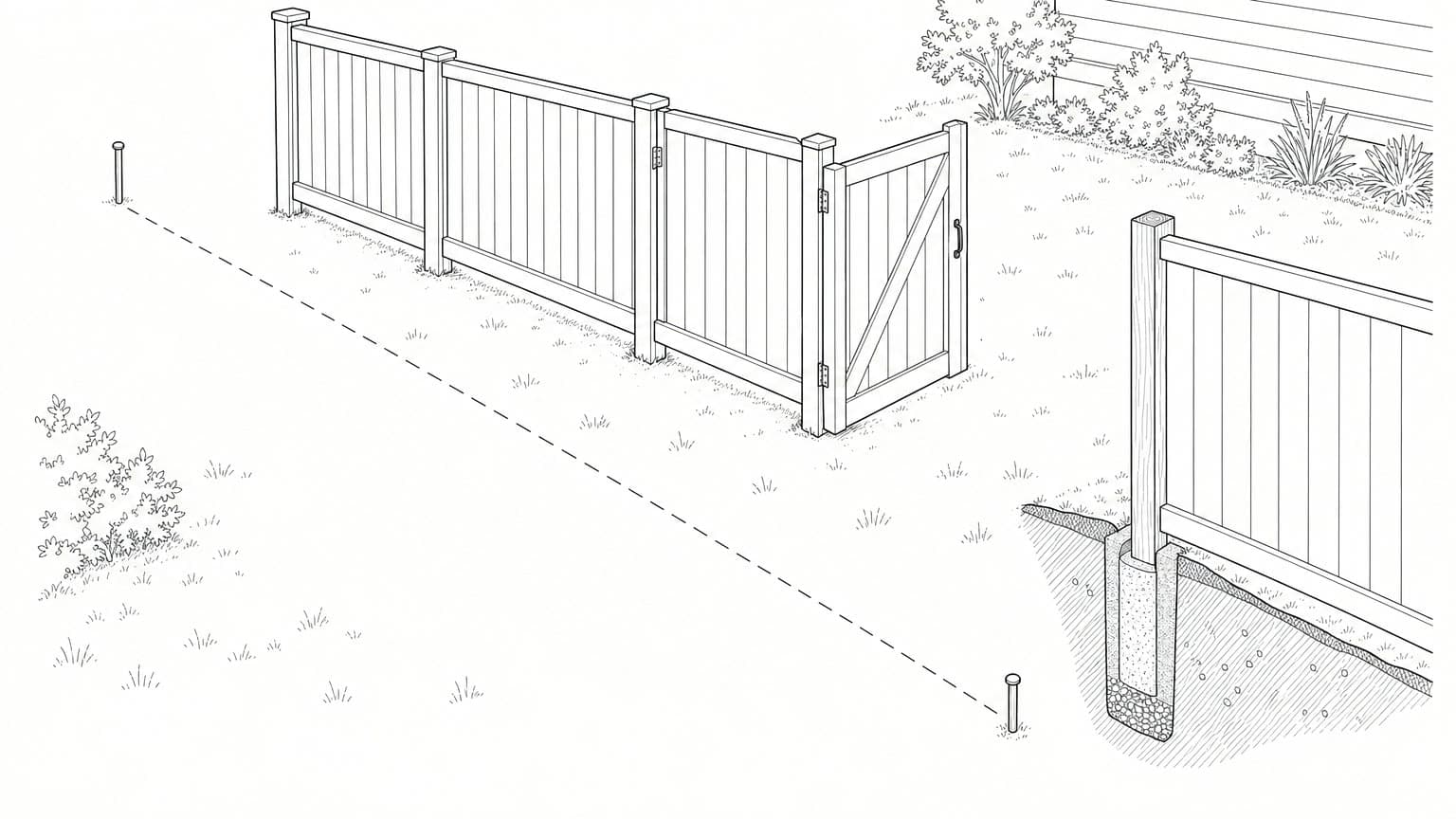
- A survey pin marks the lot corner. Find these, or get a survey, before you build.
- The real property line, which an old fence may not follow.
- Setting the fence just inside your side keeps it on your land.
- Posts set in concrete, below the local frost line.
- A gate, swinging on your side of the line.
Find the real line
Fences, hedges, curbs and garden beds get put wherever was convenient, or wherever someone guessed, or wherever the owner forty years ago wanted them. None of them mark a legal boundary. In a few cases a long-standing fence can take on legal weight through adverse possession and similar rules, but those rules are narrow, vary by place, and should never be assumed to work in your favour.
A current survey finds the corners using the iron pins or bars driven into the ground there, and shows exactly where your line runs. It also shows the setbacks, which is the other thing people get wrong. Being on your own land doesn't automatically mean you're allowed to build there.
Get a survey before you build anything permanent near the line, like a fence, shed, retaining wall or driveway extension. It's also worth it if you and your neighbour have ever disagreed about the line, if the lot is an odd shape or has an easement, or if the old fence clearly isn't straight with anything.
Check what the bylaw allows
Fence rules are set by your municipality and vary a lot, but most follow the same pattern. Fences can be lower in the front than in the back, they're restricted where drivers need to see, and the rules get much stricter around pools.
| Rule | Typical version |
|---|---|
| Front yard height | About 4 ft, sometimes lower, sometimes required to be see-through |
| Back and side yard height | Usually 6 ft, sometimes more with approval |
| Corners | A triangle at the intersection kept low so drivers can see |
| Pool enclosures | Separate, stricter rules on height, gaps and self-closing gates |
| Finished side | Many bylaws require the good side to face out |
| Setback | Some require the fence to sit entirely on your land |
In the US, the model building code exempts fences up to 7 ft from needing a building permit. That doesn't exempt them from zoning height limits, corner visibility rules or pool bylaws, which still apply.
Work it out with your neighbour
- 1.
Talk before you plan anything
Most boundary disputes could have been avoided, and most start as a surprise. A conversation before you order anything costs nothing.
- 2.
Show them the survey
A drawing tied to the corner pins moves the discussion away from opinions and onto a document neither of you wrote.
- 3.
Put the details in writing
Where the fence goes, how tall it is, what it's made of, which side faces which way, and who pays what. A short signed note is enough, and it still counts after one of you moves.
- 4.
If in doubt, build a little inside your line
Setting the fence a few inches inside your own boundary avoids almost every kind of dispute, and all it costs you is a few inches of yard.
- 5.
If something already crosses the line, get advice early
There are fixes for encroachments, like written agreements, easements and lot adjustments, but they get more expensive and more heated the longer they're left. A fence that's been over the line for a long time can gain legal weight, so don't wait.
Be clear about who owns the fence. It's usually shared if it straddles the line and yours alone if it's entirely on your land. Ownership decides who maintains it and who decides when it gets replaced. On a shared fence you can usually paint your own side, but anything that changes the fence itself, like its height or panels, is a joint decision.
Build it to last
Once the line and the rules are settled, a fence is a simple build. It tends to fail in a few predictable ways, and nearly all of them start at the posts.
| Part | What matters |
|---|---|
| Post depth | Below the local frost line, or the fence will heave and lean |
| Post spacing | Usually 6–8 ft; longer spans make the rails sag |
| Setting | Concrete footings or compacted gravel for drainage; both work if done properly |
| Post material | Pressure-treated rated for ground contact, or steel posts in a wood fence |
| Gate posts | Bigger and deeper, because gates are what pull a fence apart |
| Rails | Sized for the span and fastened so they can't twist |
| Ground clearance | A gap under the boards keeps them out of wet soil |
Pressure-treated wood is the cheapest and needs upkeep. Cedar weathers well and costs more. Vinyl and aluminum cost more again and need almost nothing afterwards. On a boundary fence, agree on the material with your neighbour even if you're paying for all of it. They'll be looking at the other side for the next twenty years.
Price a new fence in cedar, pressure-treated, vinyl or chain-link in our free fence calculator.
Open fence calculator