Pool fence rules: what the inspector checks before you fill
In many places you can't fill a new pool until the fence and gates pass inspection. The rules are written to keep small children out, and the side of the house, with its doors and windows, is where most enclosures fail.
ModelQuoter EditorialPublished Jun 17, 2026Reviewed September 2026
Applies to: US and Canada. Barrier rules come from the IRC and ISPSC in the US and from municipal bylaws in Canada. Both are strict, and both are changed locally.
What a typical project costs
Vinyl-liner pool
Medium, heater and cover
$55,730–92,900
Installed, before tax, at 2026 Greater Toronto rates.
See it on my houseOpen the calculator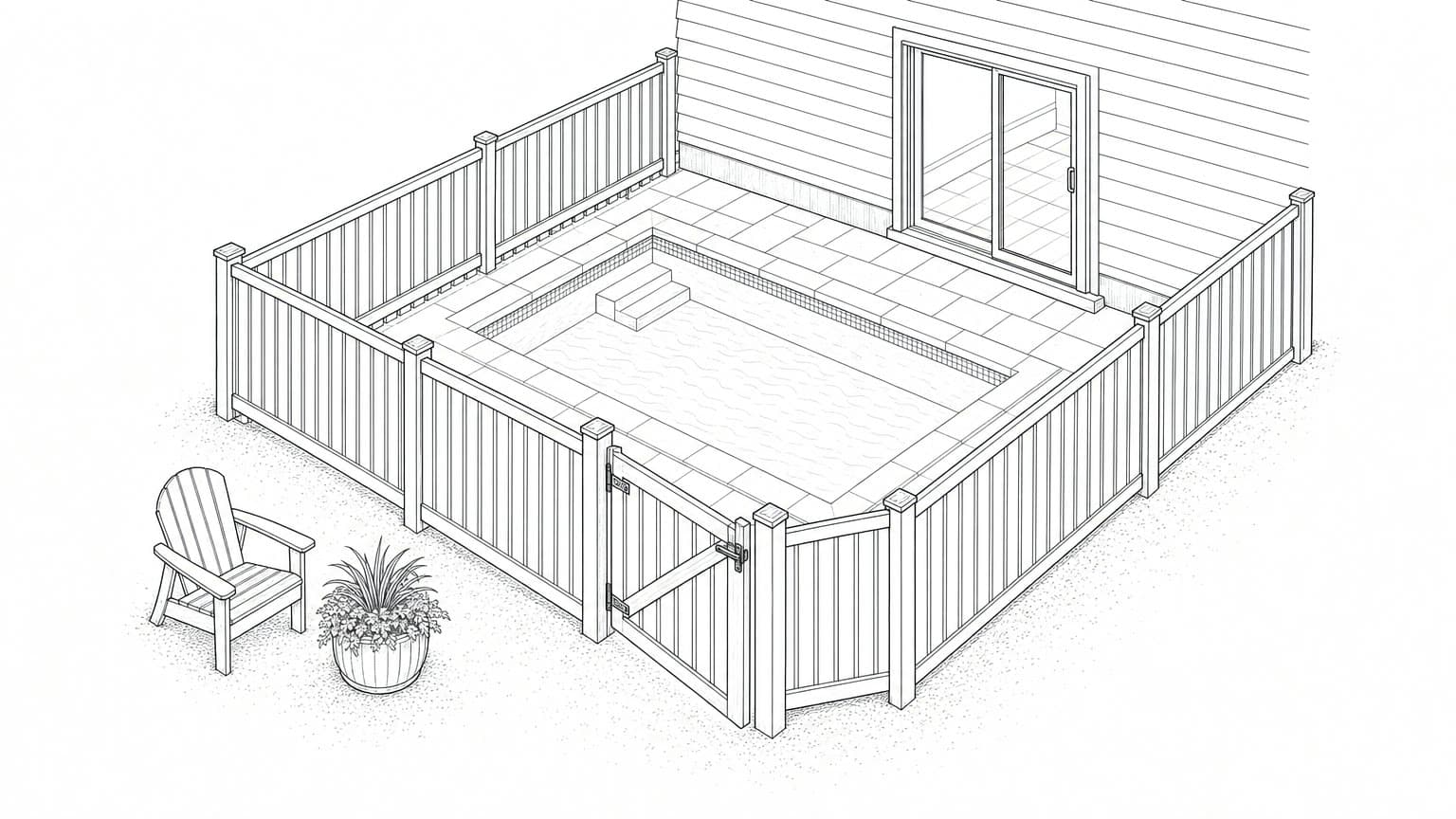
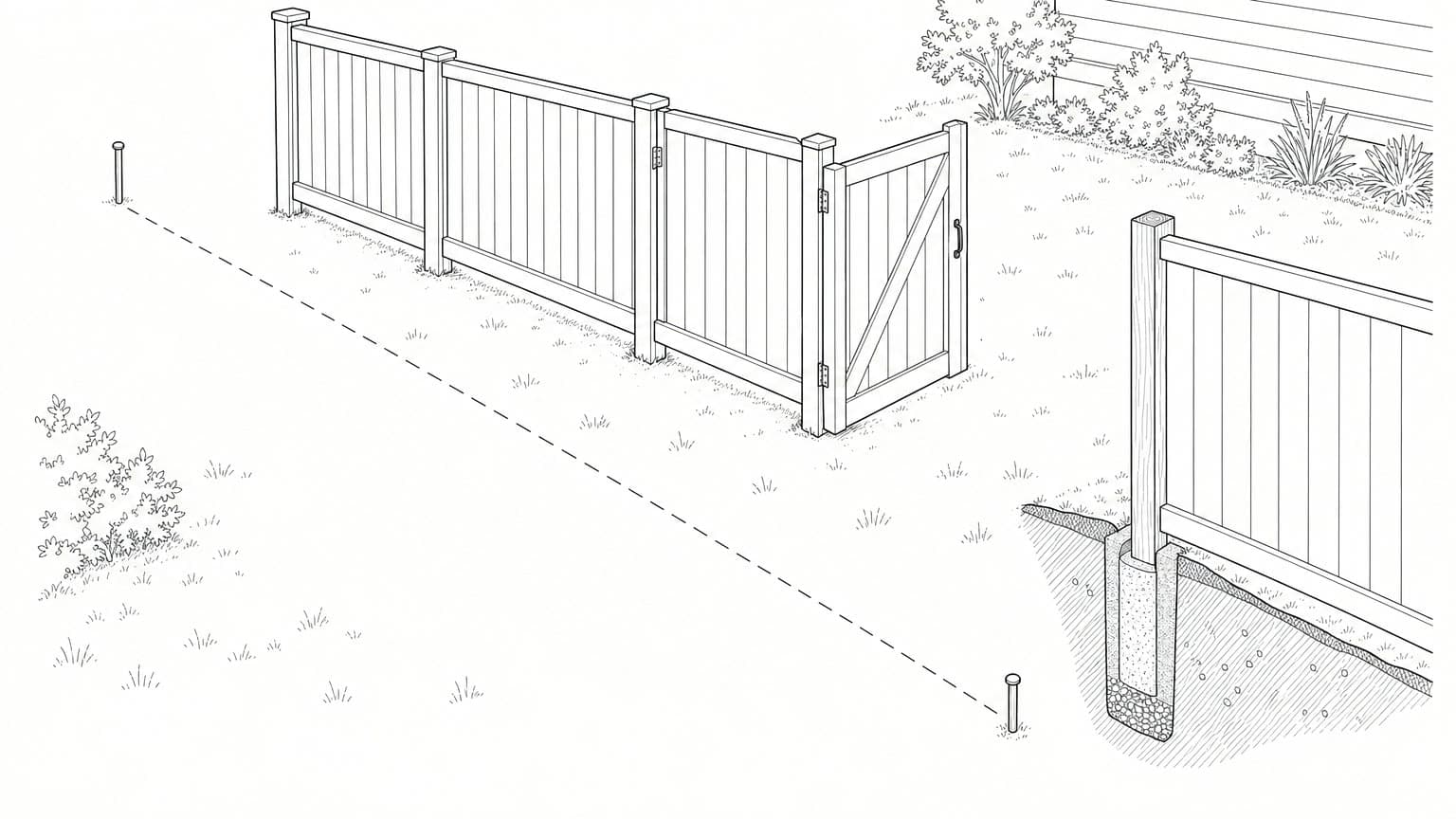
- The latch, mounted high, out of a small child’s reach.
- The gate swings outward, away from the pool, and closes and latches on its own.
- A small gap under the fence, too small to crawl through.
- When the house is part of the enclosure, its doors to the pool count too.
- Keep chairs, planters and anything climbable away from the outside of the fence.
Why the rules look the way they do
Pool rules are written around one situation: a small child reaching the water with nobody watching. Almost every specific rule, from fence height to where the latch goes, follows from that. Once you know that, the requirements are easy to remember.
The inspector's checklist
- 1.
Fence height
At least 48 inches, measured on the outside, in most places. Some require more.
- 2.
Gap at the bottom
Usually no more than 2 inches between the bottom of the fence and a hard surface.
- 3.
Openings
No gap wide enough for a child to squeeze through, measured with a test ball of a set size.
- 4.
Nothing to climb
No horizontal rails or other parts on the outside that a child could use as a ladder.
- 5.
Gates
Self-closing and self-latching, opening away from the pool.
- 6.
Latch position
High enough that a child can't reach it, or shielded so it can't be opened by reaching through the fence.
- 7.
Doors from the house
Covered below. This is where most pool enclosures fail.
When the house is part of the fence
If the house forms one side of the pool enclosure, every door and every window that opens from the house into the pool area becomes part of the barrier, with the family on the wrong side of it. Inspectors look here first. The usual options are:
- Door alarms on every door that opens into the pool area. They have to be loud, with a set delay before anyone can switch them off temporarily.
- Self-closing, self-latching hardware on those doors, with the latch out of a child's reach.
- A powered safety cover that meets the right standard, which some places accept instead.
- A separate fence around the pool itself, so the house is outside the barrier altogether. It's the simplest answer if the yard has room.
- Removable or lockable ladders on an above-ground pool, where the pool wall itself serves as the barrier.
The electrical rules
Water and electricity near a pool are regulated in detail, and the rules aren't intuitive. This is work for a licensed electrician, and it gets inspected.
| Requirement | What it covers |
|---|---|
| Bonding grid | The pool shell, deck reinforcing, ladders, rails and equipment all tied together so there's no voltage difference between them |
| GFCI protection | Pumps, lights and outlets that serve the pool |
| Outlet distances | Minimum distances from the water, plus a required outlet within a set range |
| Overhead wires | Minimum distances from overhead wires to the water |
| Underwater lights | Low voltage, approved for pools, and properly bonded |
| Equipment shut-off | Easy to reach and within sight of the equipment |
Everything else the yard has to allow for
A pool is a construction project with a landscaping project attached. The approvals often take longer than the digging, and the limits are rarely about the pool itself.
| Consideration | Why it matters |
|---|---|
| Setbacks | Minimum distances from property lines, the house, and often the septic bed |
| Lot coverage | The pool and deck count toward paved-area limits in many places |
| Easements | Nothing permanent can sit over a utility or drainage easement |
| Overhead wires | Required distances to the water are strict |
| Trees | Digging in the root zone; protected trees may not be removable |
| Access | Excavators and concrete trucks need a way into the back yard |
| Soil removal | An inground pool creates a lot of dirt that has to go somewhere |
| Equipment location | Pumps make noise, so placement affects you and your neighbours |
Access is often the last thing people think about. If machines can't get to the back yard, the job changes: smaller equipment, more hand digging, sometimes a crane, and sometimes taking down part of a fence or garden to get in. Settle the access route before you accept a quote, and agree on who repairs whatever the machines cross.
Budget for everything around the pool too. The deck, the fence, lighting, an equipment enclosure, water and electrical service, and fixing the yard afterwards are all part of the job, and a first quote often leaves them out or prices them separately.
Hot tubs, above-ground pools and insurance
Does a hot tub need a fence?
Often not, if it has a lockable safety cover rated to the right standard. Some cities require a barrier anyway, so check locally.
Does an above-ground pool need a fence?
Sometimes the pool wall counts as the barrier if it's tall enough and the ladder can be removed or locked. If a deck is built against it, the deck usually needs its own barrier.
Can I use my existing yard fence?
Only if it meets the height, gap, climbing and gate rules. Existing fences often fail on the gate hardware or on horizontal rails on the outside, and both can be fixed.
Does a pool affect my home insurance?
Most insurers need to be told, and many require a compliant barrier to keep covering you. Review your liability limits at the same time, before construction starts.
Price an inground or above-ground pool, with the deck and equipment, in our free pool calculator.
Open pool calculator