Hardwood vs. engineered vs. vinyl plank flooring
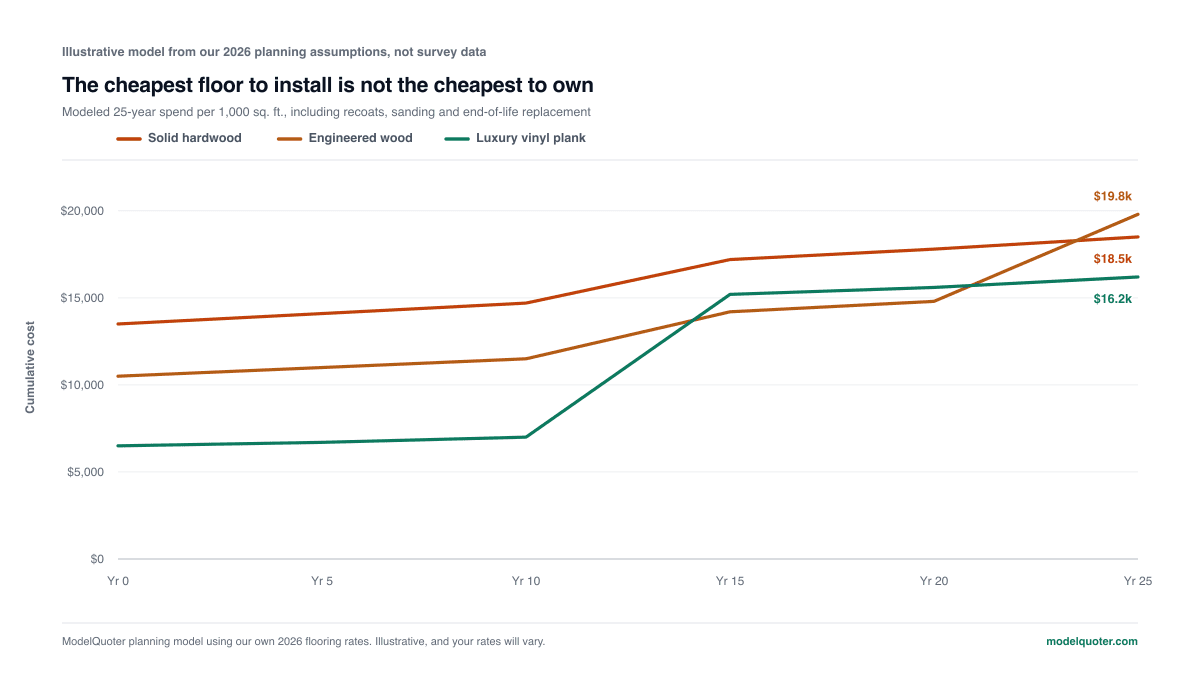
Hardwood, engineered wood and vinyl plank differ most in how they handle moisture and whether you can refinish them. Over 25 years, those two things affect what you pay more than the install price does.
ModelQuoter EditorialPublished Apr 22, 2026Reviewed September 2026
Applies to: US and Canada. The products and installation methods are the same in both.
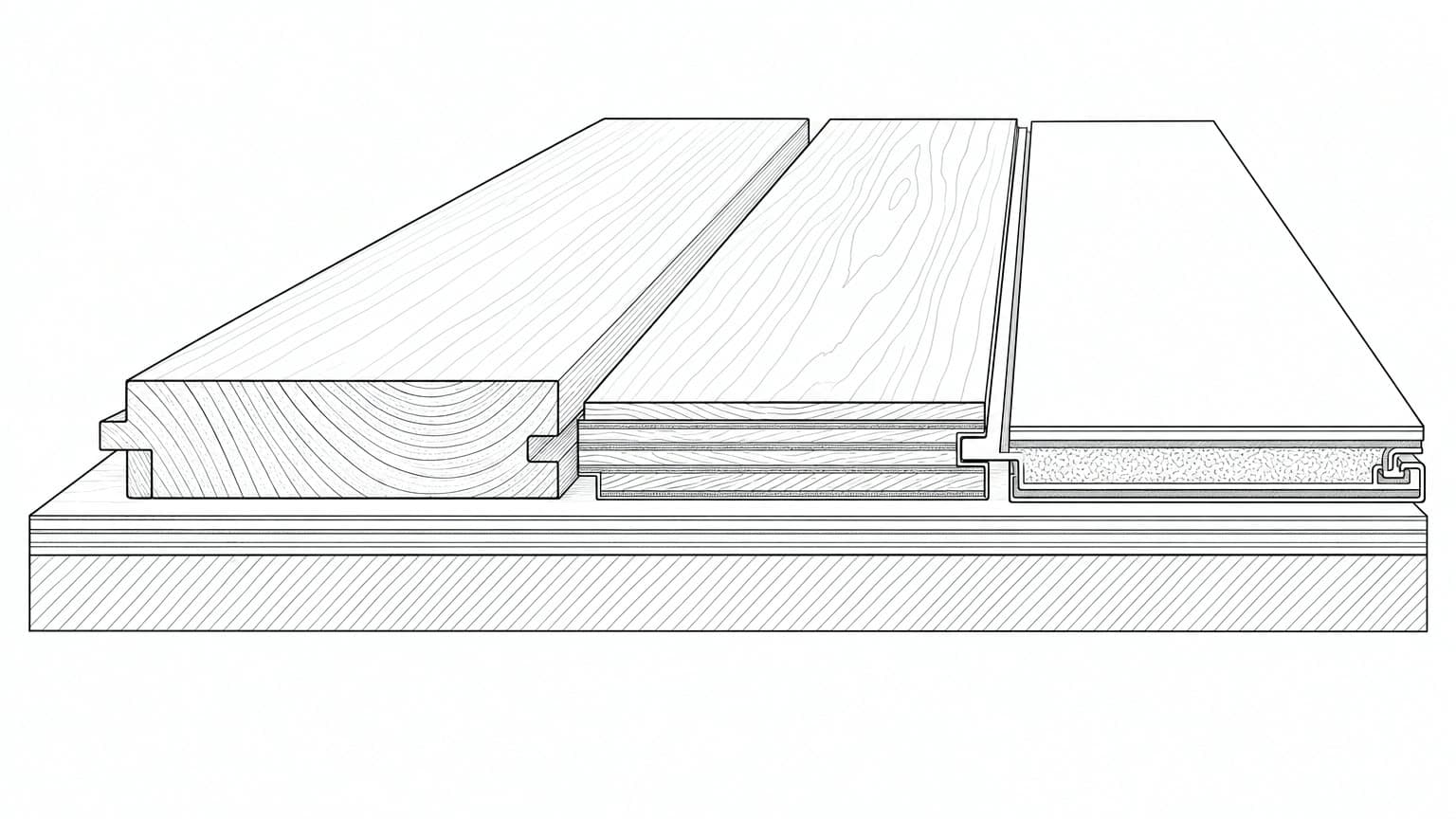
- Solid hardwood: thick enough to sand and refinish several times, but it moves with humidity.
- Engineered wood’s real-wood top layer is thin, which limits how often it can be refinished.
- Its layered plywood core keeps it stable in damp rooms and over concrete.
- Vinyl plank clicks together at the edges. Water doesn’t hurt it, but it can’t be refinished.
- The subfloor. Flat and dry matters more than which floor goes on top.
Which floor for which room
| Room | Good choices | Avoid |
|---|---|---|
| Living room and bedrooms, above grade | Any of the three | Nothing in particular |
| Kitchen | Engineered or LVP | Solid, unless you wipe up spills quickly |
| Basement | LVP, or engineered rated for below grade | Solid hardwood |
| Bathroom | Tile or LVP | Both wood products |
| Over radiant floor heat | Engineered that's rated for it | Solid, which will gap and cup |
| Over a concrete slab | LVP or engineered, floated | Solid, nailed down |
| Rentals and high-traffic areas | LVP | Engineered with a thin veneer |
If you want one floor through the whole main level, that's a good default. It makes the space feel bigger and gets rid of transition strips. Bathrooms and basements are the sensible exceptions, because there the conditions matter more than a matching look.
How each one holds up
Solid hardwood is one piece of wood from top to bottom. It swells and shrinks across its width as the humidity changes, and it can be sanded and refinished several times over many decades. That's why hundred-year-old floors still exist, and it's also why solid wood is a bad choice below grade or over concrete.
Engineered wood is a real wood veneer on a plywood core made of layers glued at right angles to each other. That makes it far more stable. It handles humidity swings and radiant heat well. Its limit is the veneer. A thick wear layer can be refinished once or twice, and a thin one can't be refinished at all. That one number matters more than the species on the label.
Luxury vinyl plank (LVP) is a vinyl product made to look like wood. It's waterproof, stable, forgiving of an uneven subfloor, and unaffected by the things that damage the other two. It also can't be repaired or refinished. When it wears through or gets gouged, you replace the plank, and when the style goes out of date, you replace the floor.
Get the subfloor right
Most flooring complaints are really subfloor complaints. Floors need to be flatter than most people expect, and every product has a limit on how much the subfloor can flex. Skipping the prep to save a few hundred dollars is how you end up with a floor that sounds hollow or has joints that open up along one line.
- 1.
Check that it's flat
Manufacturers publish a tolerance, usually a small amount over a 6- or 10-foot span. Use a long straightedge, mark the high and low spots, then grind or level them.
- 2.
Test concrete for moisture
On any slab, and especially below grade, test before you install. A calcium chloride test or a relative humidity probe costs little next to pulling up a failed floor.
- 3.
Let wood acclimatize
Wood flooring needs a few days in the room at its normal temperature and humidity. Installing it straight off the truck is a common cause of gaps the next season.
- 4.
Plan the expansion gaps
Every floating floor needs a gap around the edges, and long runs need transitions. Without them, a floor can buckle in the middle.
- 5.
Decide the order with the cabinets
Tile usually goes in before the cabinets. Floating floors go in after, because cabinets can't pin down a floor that needs to move.
What to check in the showroom
Flooring is sold by how it looks under showroom lights. The numbers that decide how it performs are on the back of the display board and in the warranty, and that's where two similar-looking floors differ.
| Spec | What to look for | Why it matters |
|---|---|---|
| Wear layer (engineered) | Thickness in mm | Under about 2mm can never be refinished |
| Wear layer (LVP) | Thickness in mil | The best single predictor of how long it looks new |
| Core (LVP) | Rigid SPC or WPC, or flexible | Rigid cores hide subfloor bumps better |
| Finish | Aluminum oxide or UV-cured | Affects scratch resistance more than the species does |
| Janka rating (wood) | Hardness number | Good for comparing woods; no floor is dog-proof |
| Warranty exclusions | Read them | Below-grade use and radiant heat are the usual exclusions |
| Attached underlay | Included or not | Changes what else you need to buy |
Take a full box home and lay it out in the room where it's going. Look at it in morning light and under your own lamps at night. Colour and sheen look completely different under showroom lighting, and the floor is the biggest surface in the room, so a shade that's a little off will bother you for years.
Order about 10% more than the measured area, and a bit more for a diagonal or herringbone pattern. Colours vary between production runs, and replacing a damaged plank in year three is far easier with a spare box in the basement than with a discontinued product.
Quick answers
Is LVP a step down from wood?
When selling a high-end home, buyers still prefer real wood in the main living areas. For a basement, a rental, a kitchen, or a house with dogs and kids, LVP is often the better choice for the conditions.
Can engineered wood be refinished?
It depends on the wear layer. At about 3mm or more, usually once or twice. Thin veneers can't be sanded at all, because you'd go through to the core.
What about waterproof laminate?
It's better than old laminate, but the core is still wood fibre. It handles spills, but standing water is another story. If moisture is your main worry, LVP or tile is the safer choice.
Replacing floors across the house? Model the rooms to scope the job and see installed costs.
Model your floors