Do you need a panel upgrade for a heat pump?
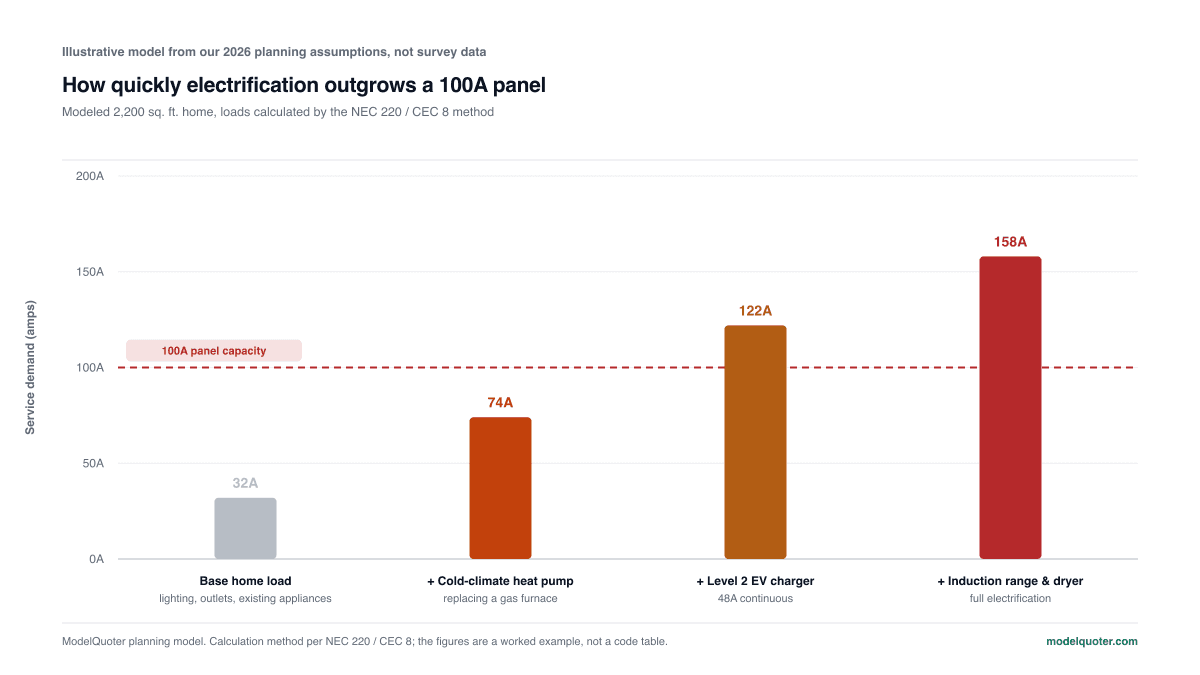
Maybe not for the heat pump alone. But a cold-climate heat pump, a Level 2 car charger and an induction range together are more than a 100-amp service was ever meant to carry, and many older houses have exactly that.
ModelQuoter EditorialPublished Jul 1, 2026Reviewed September 2026
Applies to: US and Canada. Load calculations follow NEC Article 220 in the US and CEC Section 8 in Canada. The methods differ in detail; the answer usually doesn't.
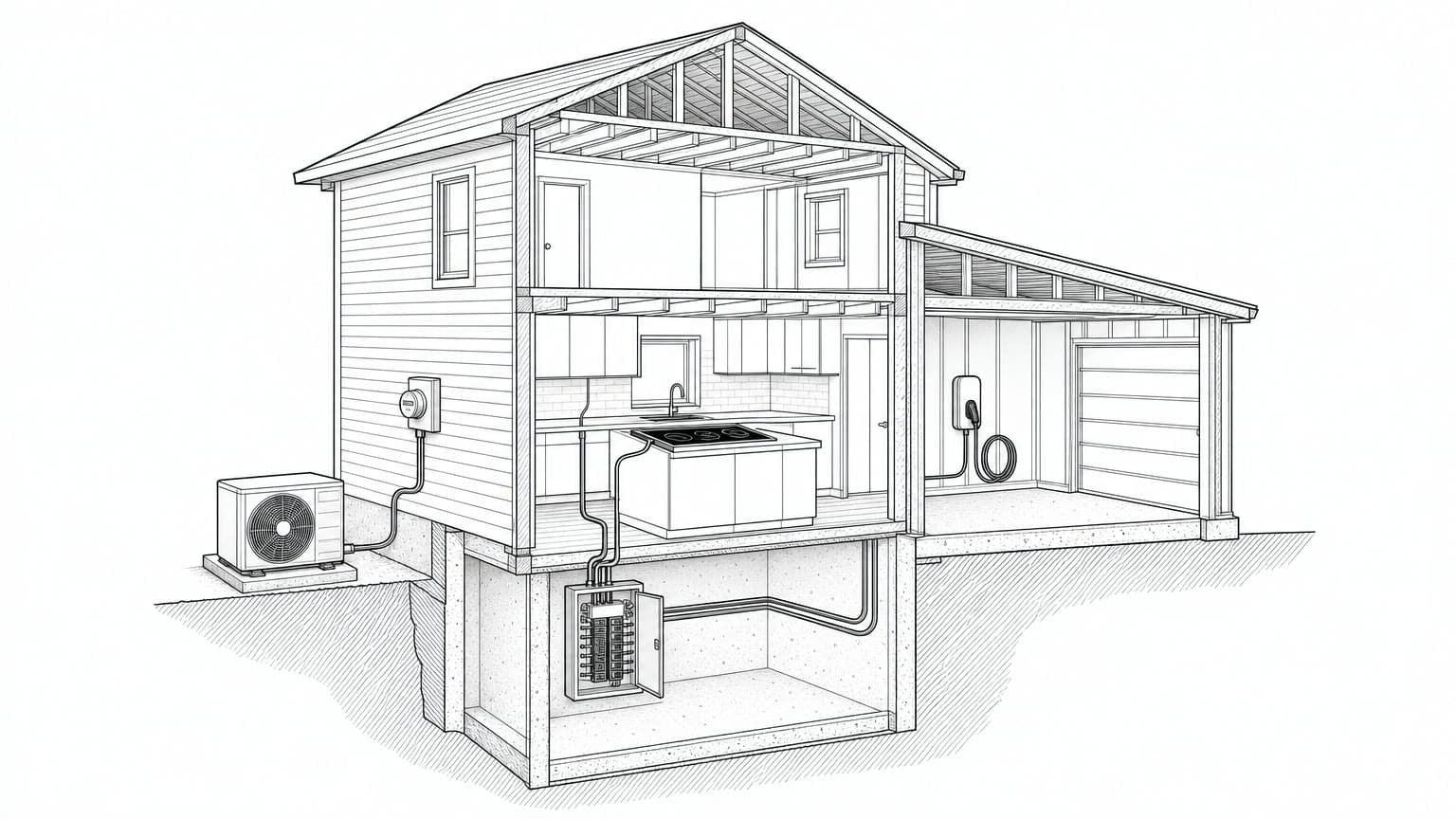
- The meter and service set how much power the house can draw in total.
- The panel. An older 100-amp service may not have room for all three new loads.
- A cold-climate heat pump, often fine on its own.
- A Level 2 car charger, one of the largest loads in a house.
- An induction range, another large circuit.
Why older houses run out of capacity
Houses built before about 1990 often have a 100-amp electrical service. That was plenty when the furnace burned gas and nobody charged a car in the garage. Every step toward going electric adds a large load that runs for hours at a time, and those loads add up faster than most people expect. Once a house is fully electric, it usually needs more than 150 amps.
What each appliance adds
| Equipment | Typical circuit | Notes |
|---|---|---|
| Cold-climate heat pump | 30–60A, 240V | The backup electric heat is the big hidden load |
| Level 2 EV charger | 30–60A, 240V | Counts as continuous, so it's calculated at 125% of its rating |
| Induction range | 40–50A, 240V | Replaces a gas stove that drew almost nothing |
| Heat pump water heater | 15–30A, 240V | Also dehumidifies and cools the room it's in |
| Electric dryer | 30A, 240V | A heat pump dryer draws far less and needs no vent |
The heat pump's backup heat is the load people underestimate most. A cold-climate heat pump works efficiently well below freezing, but most installs include electric resistance backup for the coldest hours. That backup is a big load, and the calculation has to include it even if it rarely runs.
How to know for sure
To see what service you have now, look at the main breaker in your panel. It's usually marked with its rating. If it says 100, that's your service size, though the panel rating and the actual service wires can differ, which is one more reason to have it checked properly.
Ways to avoid a service upgrade
Upgrading the service is disruptive and involves the utility. A calculation that shows you're over capacity doesn't automatically mean you need a new service. Try these first.
- 1.
Add a load management device
Codes increasingly accept devices that stop two big loads from running at the same time, often an EV charger and one other appliance. Both get installed, only one draws power at a time, and the calculated load drops.
- 2.
Use a smart panel or circuit-level controls
These watch your usage and switch off loads when needed, which can keep a 100A service working through several upgrades. They cost more than a simple interlock and much less than a new service.
- 3.
Pick equipment that draws less
A heat pump water heater instead of a standard electric one, a heat pump dryer instead of a vented electric one, a car charger set to a lower amperage. Charging overnight rarely needs the full rate.
- 4.
Cut back the backup heat
Sizing the heat pump properly and limiting the electric backup removes the single biggest load. Some people keep their gas furnace as the backup, which removes it entirely.
- 5.
Upgrade the service if you still need to
That means a new panel, meter base, service wires and utility connection. Budget time for the utility's schedule, which is often the longest part.
Getting the heat pump itself right
Heat pumps are less forgiving of a bad install than the equipment they replace. An oversized gas furnace wastes some fuel. An oversized heat pump turns on and off constantly, doesn't pull humidity out properly, and costs more to run than one sized correctly.
- Ask for a proper load calculation. A room-by-room heat loss and gain calculation, such as Manual J, based on your actual walls, insulation, windows and which way the house faces. Sizing from the floor area or from the old furnace just carries forward whatever was wrong before.
- Check the ducts. Heat pumps move more air at a lower temperature than a furnace. Ducts sized for a furnace are often too small, and you'll notice it as noise and weak airflow in the rooms farthest from the unit.
- Decide on the backup heat on purpose. Electric backup is simple, and it's the biggest load in your calculation. Keeping the gas furnace as backup avoids that load, but it means keeping a gas appliance.
- Seal and insulate first if you can. Every improvement to the house shrinks the heat pump you need, which lowers the purchase price and the electrical load. Doing it the other way round means buying a bigger unit than the house will end up needing.
- Plan for defrosting. The outdoor unit drips water when it defrosts. Mount it on a stand above the snow line, where the meltwater won't freeze on a walkway.
Quick answers
Do heat pumps work in cold weather?
Cold-climate models are rated to give useful heat well below freezing, and they're widely used in cold regions. They get less efficient as it gets colder, which is what the backup heat is for. Sizing and installation matter more than the brand.
Is 200 amps always the right upgrade?
It's the usual choice, and it makes sense if you're doing the work anyway. The calculation may show that 150 amps would do, but the extra cost of going to 200 is small compared with the cost of the job.
Will I need a new panel as well as a new service?
Often, yes. They're usually done together, because an older panel usually doesn't have the capacity or the spaces for new circuits. Breakers for some older panel brands are also hard to find, which is another reason to replace it.
Planning a heat pump, panel upgrade or energy retrofit? Model the project to scope the work before you call electricians.
Model your retrofit