How to avoid scope creep and surprise change orders
Most change orders come from decisions nobody made when the job was quoted, which then get priced mid-project by the only contractor on site. Settling those decisions before demolition prevents most of the extras.
ModelQuoter EditorialPublished Aug 18, 2026Reviewed September 2026
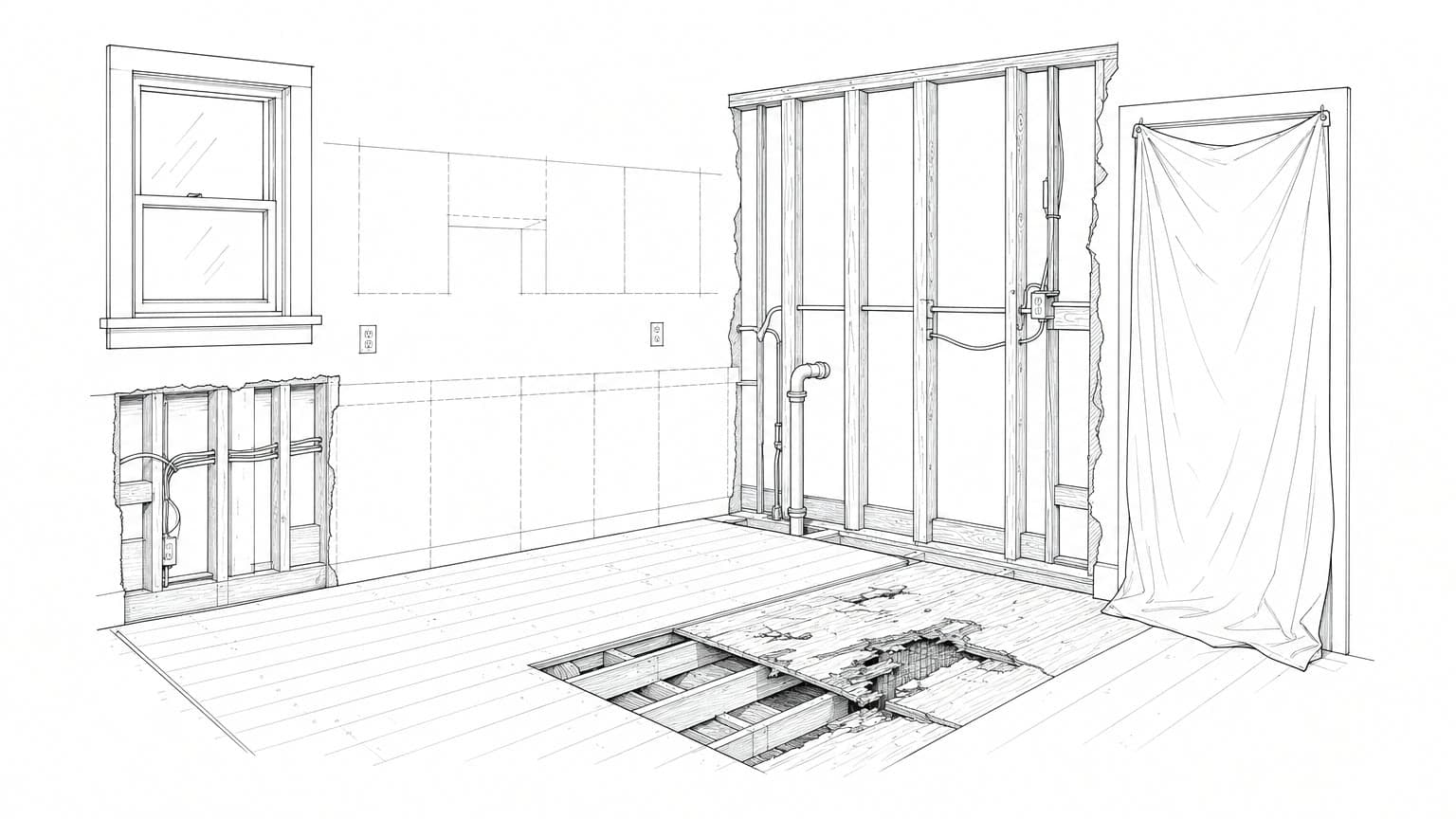
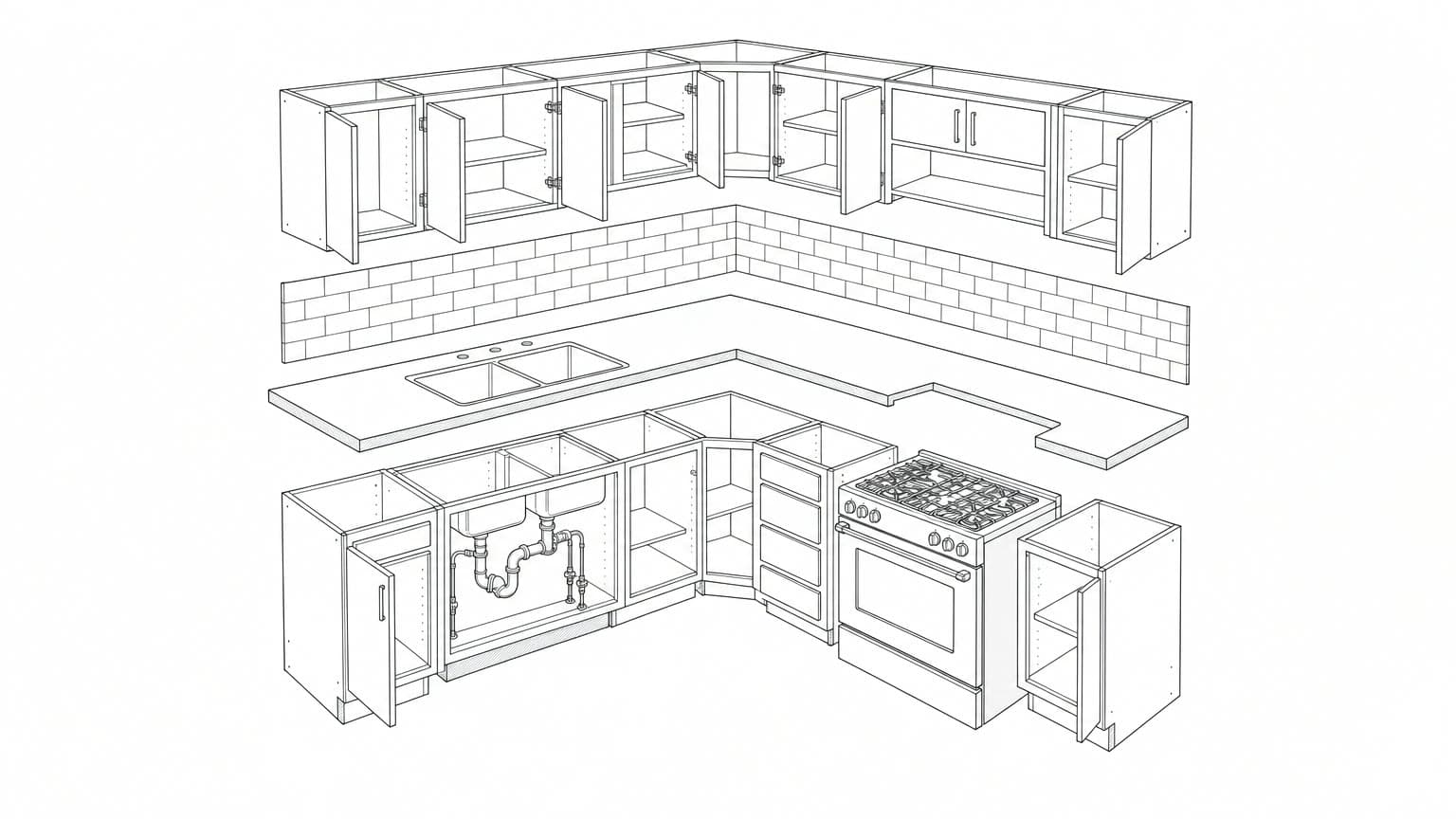
- The plan: new cabinets, marked on the wall in pencil.
- Old wiring behind the wall, a decision nobody made when the job was quoted.
- A pipe right where a new cabinet has to go.
- Damaged subfloor, found only once the old floor came up.
Where change orders come from
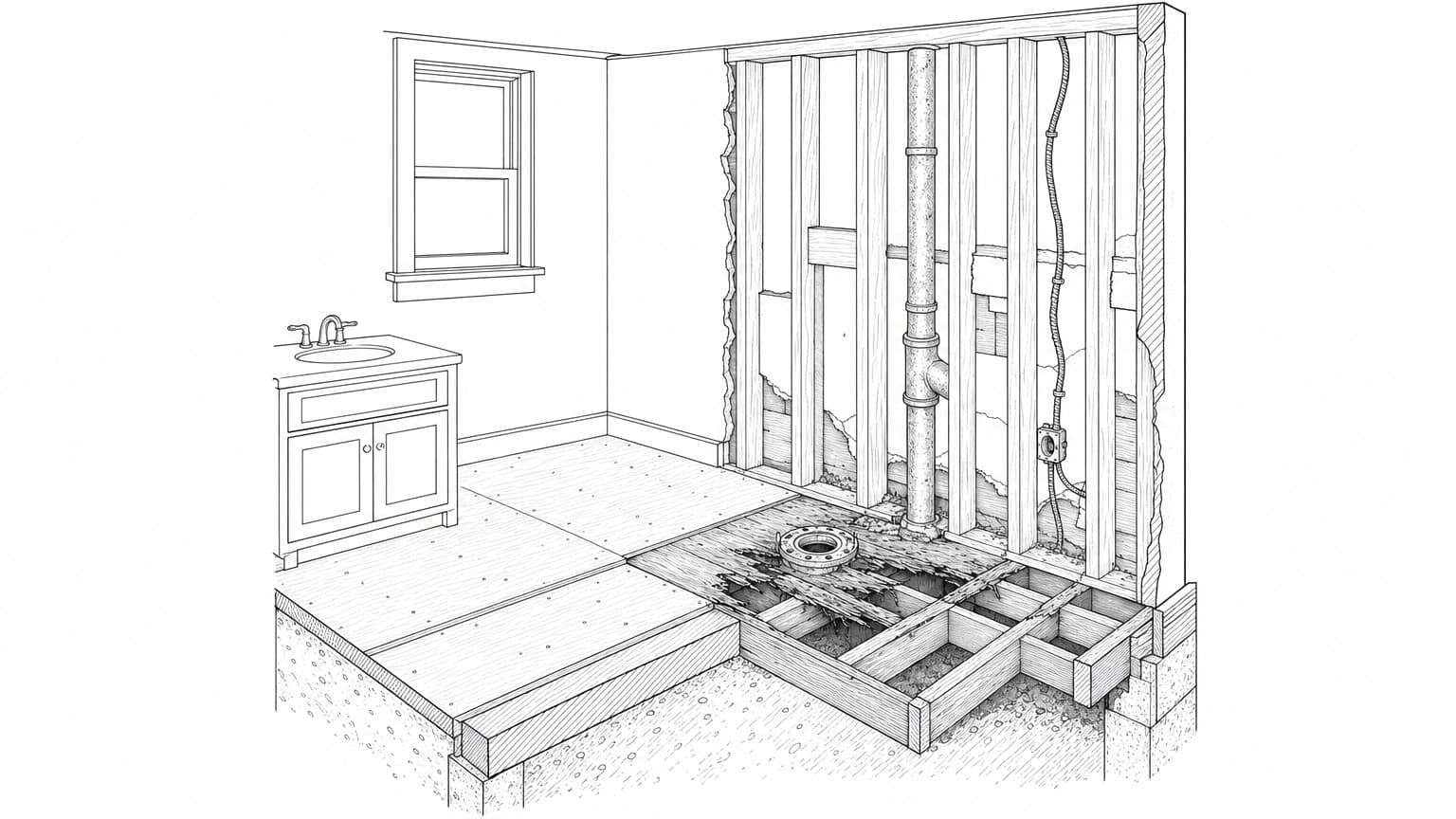
- Things nobody could have seen. Rot, old knob-and-tube wiring, an unmarked drain. Open a 1950s wall and you might find cloth-wrapped wiring that nobody could have priced. A contingency covers finds like that.
- Decisions put off at quoting time. Fixtures and finishes nobody chose. These are the expensive ones, and you can prevent them.
- Changes you decide to make. Perfectly legitimate, and the ones you control.
A quote that says "allowance: $4,000 for tile" hasn't priced your tile. It has put off the decision until you're standing in a showroom, with the old floor already torn out and nothing left to negotiate with.
How a budget drifts
Say you sign a $40,000 bathroom and kitchen refresh. None of these changes looks unreasonable on its own:
| Change | Why | Added cost |
|---|---|---|
| Two extra outlets in the kitchen | Decided on site | $600 |
| Subfloor repair under the old tub | Found at demolition | $1,800 |
| Tile upgrade over the allowance | Chosen in week three | $1,200 |
| Moving the vanity drain | Layout changed after rough-in started | $2,400 |
| Extra pot lights | Added while the ceiling was open | $900 |
| Drywall repair around old plumbing | Found at demolition | $1,100 |
| Total | $8,000, or 20% of the contract |
Only two of those six were true surprises. The rest were decisions that could have been made before the contract was signed, and each one was priced by a contractor who knew you had no other option. Keep one running list of every change with the revised total at the bottom, and read the total before you approve the next one.
Before demolition starts
The cheapest time to change your mind is before anyone has started the job. Once the crew is on site, every decision gets priced by someone who knows you can't shop around, and every delay costs them a day of crew time.
- 1.
Pick every finish by product
The model number, colour, finish and size. Not "brushed nickel fixtures" but the actual faucet. If it has a lead time, find out now, not in week three.
- 2.
Turn allowances into line items
Go through each allowance and replace it with a real choice and a real price. For anything that has to stay an allowance, write down exactly what it assumes.
- 3.
Agree on how changes get priced
The markup on labour and materials, who can approve a change, and a rule that no unapproved work goes ahead. Settle this now, while there's nothing to argue about.
- 4.
Investigate what you can
On an older house, cutting one inspection hole or scoping the drain costs little next to finding the same problem mid-project.
- 5.
Set aside a contingency
Hold back 10–20% of the contract price, more on an older house, and keep it separate from the budget you share with the contractor. That money is there so a real surprise doesn't stop the job, so leave it alone for anything else.
What a change order should say
| What it includes | Why |
|---|---|
| What changed, in plain words | So someone else could tell what was agreed months later |
| Why it changed | Separates a real discovery from something missing in the original quote |
| The cost, split into labour and materials | So you can see the markup |
| The effect on the schedule, in days | Changes cost time, and time is where the next argument starts |
| The new contract total | The running number, so nobody is surprised at the end |
| Both signatures and a date | A change order signed by only one side is just a quote |
Find the unknowns early
You can't write the unknown out of a contract, but you can shrink it, usually for a few hundred dollars, and always for less before signing than after.
| Unknown | How to check early | What it saves you from |
|---|---|---|
| Wiring in a house built before 1970 | Pull two or three outlets and look | Finding out you need a whole-house rewire at rough-in |
| The condition of the drain | A camera scope of the main line | Digging up a collapsed sewer pipe mid-renovation |
| What's inside a wall you want removed | One inspection hole, patched afterwards | Learning the wall is structural after demolition starts |
| Asbestos or lead | Testing before demolition, which is often required | A stop-work order and an abatement contractor |
| The foundation and moisture | Look during heavy rain, not in August | Finishing a basement that turns out to leak |
When contractors are quoting, ask each one what they'd want to check before they commit to a fixed price. Their answers show you where the risk sits, and a contractor who wants to open one hole before pricing is showing you the kind of judgment you want on your job.
Common questions
Are change orders always a bad sign?
No. On an older house some are unavoidable, and a contractor who documents them properly is doing it right. What matters is how many. A handful of real discoveries is normal. A steady stream suggests the original scope was thin.
Can I refuse a change order?
You can say no to the change if the work is optional. You can't refuse a repair the code requires and still pass inspection. Ask which kind it is, and ask for the code reference if it's the second kind.
What markup is reasonable on a change order?
Usually about the same as the markup already built into the contract, commonly 10–20% on labour and materials. The trouble is rarely the percentage. It's that nobody agreed on one in advance, so it shows up for the first time on an invoice.
Get the scope written down before contractors bid. Model your project to get an itemized scope breakdown and an instant estimate.
Model your project