How much deposit should you pay a contractor?
A fair deposit is usually 10–20% of the job, and in some states the law sets the limit for you. After that, pay as the work gets done, and hold back the last 10% until the deficiency list is cleared.
ModelQuoter EditorialPublished Feb 4, 2026Reviewed September 2026
Applies to: US and Canada. Several US states cap home-improvement deposits by law. Most Canadian provinces don't, but written-contract and cancellation rules still apply.
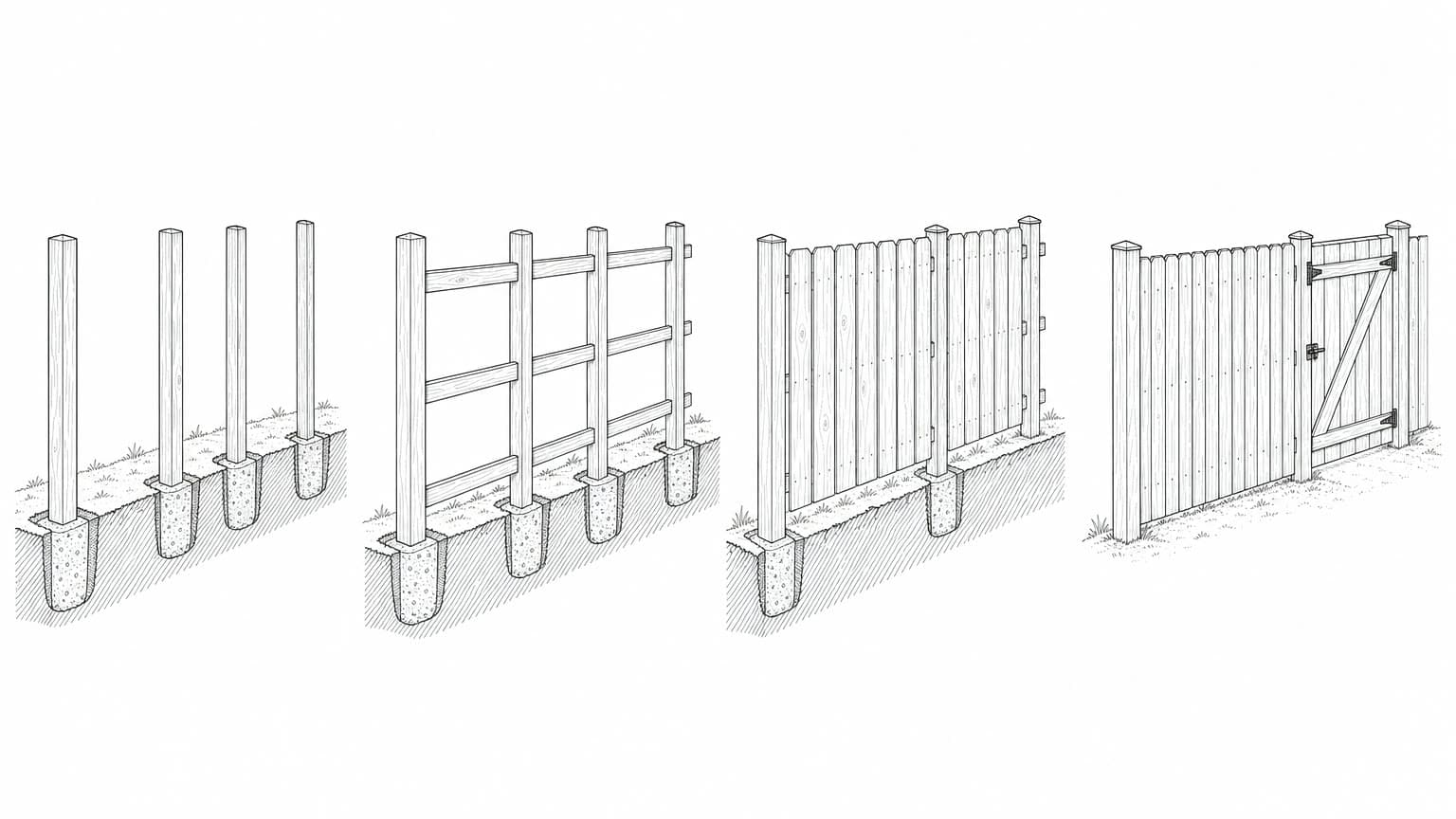
- Posts set in concrete: the first stage you can see and check.
- Rails on. Pay for work that’s done, not work that’s coming.
- Boards on: most of the job finished, and most of the money paid.
- Gate hung and the yard cleaned up. Hold back the last 10% until the deficiency list is cleared.
The short answer
Pay 10–20% up front, or whatever your state's cap is if that's lower. Pay the rest in stages as work is finished and inspected. Keep 10% back until every item on the deficiency list is fixed. Never pay 50% before anyone has set foot on your property.
A deposit is there to cover the contractor's real costs before they start: special-order materials, a deposit to a supplier, holding a crew for your dates. That's fair to pay for. A deposit isn't meant to fund the contractor's business.
When a contractor needs half the price of your project before starting, that money is often paying for materials on the job they're finishing now. It works until one customer pauses, and then the shortfall lands on whoever is at the back of the line. When homeowners lose a deposit, this is a common reason. The contractor was running each job on the next customer's deposit, and one link in the chain broke.
Where the law limits deposits
| Where | Deposit rule | Source |
|---|---|---|
| California | $1,000 or 10% of the contract price, whichever is less | Business and Professions Code § 7159.5 |
| Massachusetts | One third of the contract price, or the cost of special-order materials if that's more | M.G.L. c. 142A |
| Nevada | $1,000 or 10%, the same test as California | State contractor law |
| Ontario | No cap, but a direct agreement over $50 must be in writing, with a 10-day cooling-off period | Consumer Protection Act, 2002 |
| Other Canadian provinces | Generally no cap | Provincial consumer protection law |
If you live somewhere with a cap and a contractor asks for more, they're asking you to help them break the law. That alone tells you a lot.
How to set up the payments
A schedule tied to dates pays for time. A schedule tied to milestones pays for progress, and you'll notice the difference the first week something slips.
Each milestone has to be something you and the contractor can both look at and agree is done. "Rough-in complete and inspection passed" is a milestone. "50% complete" is an opinion.
| Stage | Weak trigger | Milestone you can check |
|---|---|---|
| Start | Contract signing | Materials delivered to site and permit issued |
| Structure | End of week two | Framing inspection passed |
| Systems | 50% complete | Electrical and plumbing rough-in signed off |
| Finishes | Tiling started | Tile set, grouted and cured; deficiencies listed |
| Close-out | Crew leaves site | Final inspection passed and deficiency list cleared |
For the last payment, walk the job with the contractor on the day it looks finished and write down every deficiency. Agree that the final payment is released when that list is done. It's far easier to do this in writing on the day than to piece it together three weeks later over email.
How to tell if a deposit is reasonable
- Ask what the deposit pays for. "The cabinets and the stone deposit" is an answer. "That's just how we work" isn't.
- Ask to see the supplier quote. For special-order items, the contractor will already have one. If your deposit matches a real invoice, you can check the number.
- Look at when it's due. A deposit due at signing, weeks before anything is ordered, is funding the business. One due when the order is placed is funding your job.
- Compare the three bids. If two contractors want 15% and one wants 45% for the same work, the third one is telling you something about their cash flow.
- Compare it to the first stage. If you've paid more up front than the first stage of work is worth, you're carrying the risk.
If a contractor won't return your deposit
- 1.
Put your demand in writing
Send an email with the date and the exact amount you want back. Even if you've been calling for weeks, the written record is what every later step relies on.
- 2.
Check whether the deposit broke the law
If you live in a state with a cap and the contractor took more, that's a licensing violation as well as a contract problem, and it gives the licensing board more to act on.
- 3.
File a complaint with the licensing body
State contractor boards and provincial consumer protection offices take deposit complaints seriously, and a licensed contractor has a licence to lose. Filing is free and is often faster than court.
- 4.
Look for a recovery fund
Some places, including California and Maryland, run a fund for consumers who lose money to a licensed contractor. The rules are strict, so read them before you count on it.
- 5.
Use small claims court if the amount fits
Most deposit disputes fall under small claims limits, and you don't need a lawyer. Bring the contract, your written demand and proof of payment.
Deposit questions
Is asking for any deposit a red flag?
No. Special-order cabinets, windows and stone have to be paid for before they arrive, and it's normal for the contractor to ask you to cover that. What matters is whether the amount matches a real cost you can see on the quote.
The contractor offered a discount for cash. Should I take it?
You'd be trading a small saving for all of your protection. With no paper trail you have no proof of payment, nothing to hold them to on a warranty claim, and nothing to show a licensing board. If you do pay cash, get a signed, dated receipt every time.
What's a holdback, and how is it different from a deposit?
They're at opposite ends of the job. A deposit is paid before work starts. A holdback is money you keep back at the end, usually 10%, until deficiencies are fixed and subcontractors are paid. In some places the holdback is required by law.
Can I use escrow for a renovation?
Yes, and it's worth asking about on bigger projects. A third party holds the money and releases it at agreed milestones, so there's no argument about whether a payment is due. Expect a fee, and expect some contractors to say no.
Model your project to get a written scope and an instant estimate. It makes it much easier to set a deposit and milestone payments that match the actual job.
Model your project